
She was born into disgrace, declared illegitimate at three years old, her mother beheaded on her father’s orders, her place in the line of succession a matter of political whim. By the time Elizabeth Tudor was crowned Queen of England on January 15, 1559, she had already survived imprisonment in the Tower of London, house arrest at Hampton Court, and the unrelenting scrutiny of a court that doubted her very right to rule.
Yet for 45 years, from 1558 until her death in 1603, Queen Elizabeth I held together a kingdom riven by religious conflict, aristocratic rivalry, and foreign aggression. In an era when the Scottish preacher John Knox thundered against the “monstrous regiment of women” as a direct affront to God and nature, Elizabeth not only reigned but dominated. How she did it remains one of the most compelling stories in the history of statecraft.
A Throne Built on Quicksand: The World Elizabeth Inherited
When Elizabeth ascended to power, England was exhausted. Her half-brother Edward VI had died at fifteen, leaving behind a country lurching toward Protestant extremism. Her half-sister Mary I, “Bloody Mary”, had reversed course violently, burning nearly 300 Protestants at the stake and plunging the nation into religious terror. Mary’s marriage to Philip II of Spain had made England a satellite of a foreign Catholic power. By the time Mary died childless in November 1558, England was impoverished, diplomatically humiliated, and spiritually fractured.
Elizabeth was twenty-five years old and, in the eyes of much of Catholic Europe, illegitimate. Her mother Anne Boleyn had been executed as a traitor and adulteress in 1536. A condemnation that technically made Elizabeth a bastard. Her coronation procession through London on January 14, 1559 was as much a theatrical act of legitimacy as a celebration. Every gesture, every detail of ceremony was carefully choreographed to reinforce her right to rule, because the historical reality of her birth made it legally contestable.
That instinct for performance and control would define her entire reign.
The Virgin Queen: Marriage as a Weapon, Not a Goal
The most pressing political demand placed on Elizabeth from the first days of her reign was the same one placed on every female monarch: marry and produce an heir. Parliament petitioned her repeatedly. Foreign princes courted her. Her own councillors, including the formidable William Cecil, urged her to secure the succession before Catholic rivals could exploit the uncertainty.
Elizabeth refused, but she refused cleverly. Rather than rejecting marriage outright, she turned courtship into a decades-long diplomatic instrument. She dangled the possibility of her hand before Philip II of Spain, Archduke Charles of Austria, Robert Dudley (the Earl of Leicester), François, Duke of Anjou, and a succession of other suitors, stringing along negotiations for years, sometimes decades, while extracting political concessions, alliances, and leverage with each.
As long as she remained unmarried, she remained sole ruler of England. A foreign husband would import foreign interests. An English noble elevated to king consort would become, in the language of the time, an overmighty subject, a repeat of the baronial chaos that had destroyed the Wars of the Roses. Elizabeth had studied history. She did not intend to repeat it.
Her decision to remain the Virgin Queen was not sentiment. It was strategy of the highest order, transforming what her critics called weakness, a woman without male protection, into an extraordinary concentration of personal power.
The Cult of Gloriana: Branding Before the Word Existed
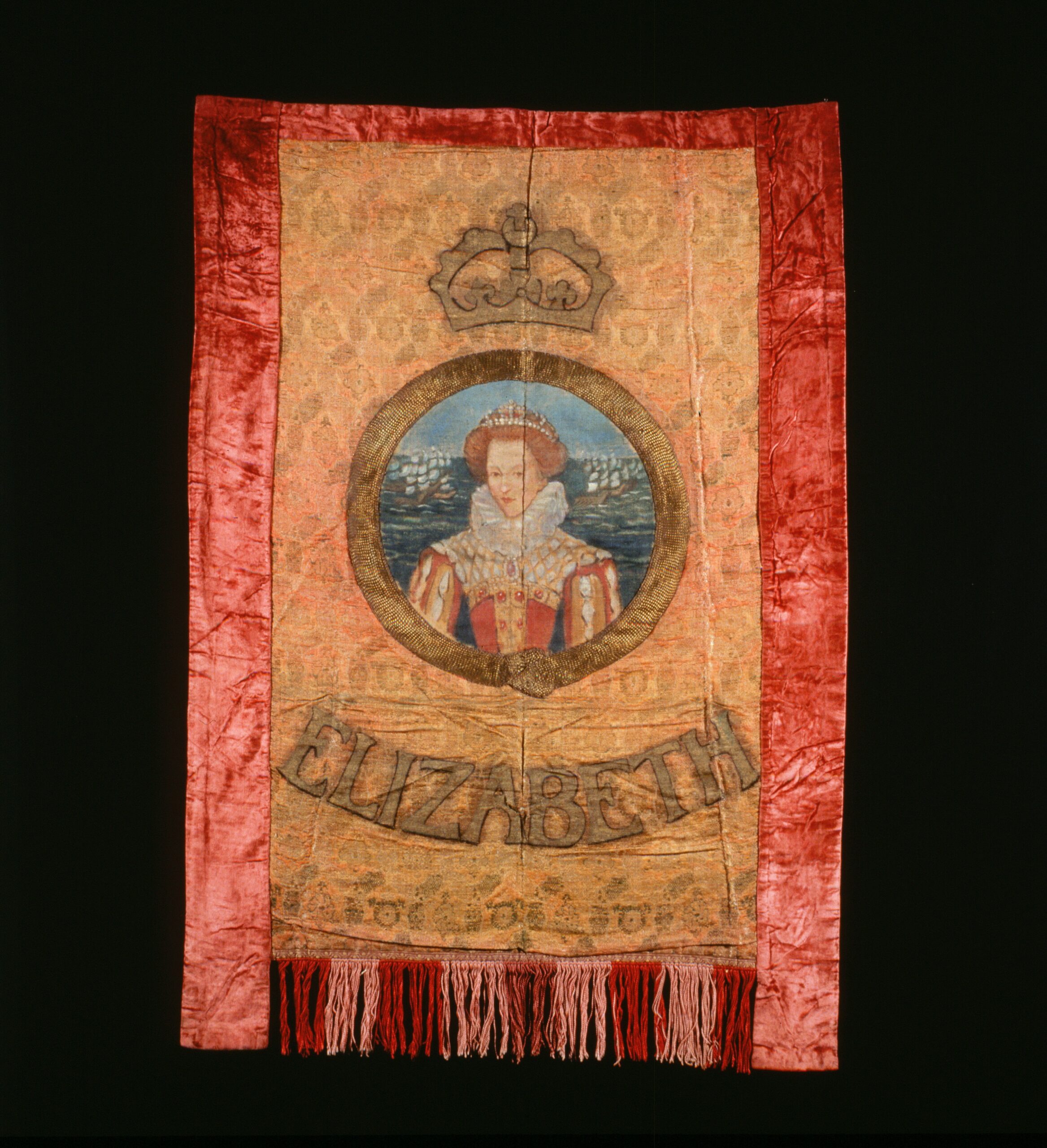
Elizabeth understood something no European monarch of her era fully grasped: that a ruler’s image is as powerful as their armies. Over four decades, she and her court built what historians now recognise as one of history’s most sophisticated propaganda campaigns.
She commissioned portraits, dozens of them, that depicted her as timeless, radiant, and divine. The famous Armada Portrait of 1588 shows her hand resting on a globe, the defeated Spanish fleet visible in the background, projecting the image of an empire-builder rather than a besieged island monarch. As she aged and the pockmarks left by a near-fatal bout of smallpox in 1562 took their toll, the portraits became increasingly idealised and formulaic. This was not vanity. It was deliberate image management: the queen as symbol, not as mortal.
She travelled extensively on royal progresses, extended summer tours of her kingdom, staying in the grand houses of the nobility at their own considerable expense, appearing before crowds of common subjects in carefully staged pageantry. These progresses kept her visible, kept her popular, and cleverly burdened her potentially restive aristocracy with the ruinous cost of hosting the royal court.
The cult of Gloriana, the semi-divine queen-goddess celebrated by Edmund Spenser in The Faerie Queene, was not simply a poet’s tribute. It was an official ideology of rule, as carefully cultivated as any military campaign.
Walsingham’s Web: The Intelligence Empire That Kept Her Alive
Elizabeth’s survival was not merely a matter of image. The Tudor court was a genuinely lethal environment. Between 1569 and 1586 alone, she faced the Northern Uprising (1569), the Ridolfi Plot (1571), the Throckmorton Plot (1583), and the Babington Plot (1586), all of them Catholic-backed conspiracies to assassinate her and replace her with Mary, Queen of Scots.
Her answer was Sir Francis Walsingham, appointed Principal Secretary and Privy Councillor, who built what historians have called England’s first modern intelligence service. Walsingham maintained informants at twelve locations across France, nine in Germany, four in Italy, four in Spain, and three elsewhere across Europe,with additional contacts in Constantinople, Algiers, and Tripoli. It was said that secret communications sent from Rome were known in London before they reached Madrid.
His agents infiltrated Catholic exile networks, intercepted ambassadorial correspondence, practised secret inks and substitution ciphers, and embedded double agents inside conspiratorial circles. The Babington Plot, the most dangerous of all, explicitly naming the assassination of Elizabeth and the liberation of Mary Queen of Scots, was broken when Walsingham’s men cracked coded letters concealed in beer barrels delivered to Mary’s prison at Chartley. When Mary’s written reply sanctioned the plan, it sealed her fate. She was executed in February 1587.
The intelligence operation Walsingham ran was not a private initiative. It was understood, sanctioned, and politically directed by Elizabeth herself, who then, with characteristic deniability, claimed she had not intended Walsingham’s secretary Davison to actually deliver the death warrant. The genius of Elizabeth’s rule lay partly in this: she could deploy ruthlessness while maintaining the appearance of reluctance, keeping her hands clean while the machinery of state worked its will.
The Privy Council: Governing Through Controlled Rivalry
Elizabeth’s management of her inner circle was as sophisticated as any of her external manoeuvres. She deliberately cultivated factions within her Privy Council, setting advisors against one another and ensuring that no single figure accumulated enough power to overshadow the crown. William Cecil (later Lord Burghley) and Robert Dudley (the Earl of Leicester) were rivals for influence throughout much of her reign, both useful to her, neither allowed to dominate.
She was famously reluctant to make decisions, a trait that infuriated her ministers but which served a clear political purpose: it kept options open, maintained her freedom of manoeuvre, and prevented her councillors from presenting her with faits accomplis. When Parliament pressed her on marriage, on the succession, on the fate of Mary Queen of Scots, she deflected, delayed, and negotiated, driving Cecil to distraction but preserving her autonomy.
This was not indecisiveness. It was a ruler who understood that in a court where every commitment created enemies, ambiguity was power.
The Armada and the Tilbury Speech: Command in Crisis
The defining test of Elizabeth’s rule came in the summer of 1588. Philip II of Spain, who had been accumulating grievances against England for years, over English piracy against Spanish shipping, English support for Protestant rebels in the Netherlands, and the execution of his former ally Mary Queen of Scots, dispatched the 130-ship Spanish Armada with orders to escort a Spanish invasion force across the English Channel.
On August 9, 1588, as English troops gathered at Tilbury on the Thames estuary, Elizabeth rode among them on horseback in armour and delivered one of the most celebrated speeches in English history. She acknowledged the physical reality of her situation, a woman standing before an army, and then transcended it entirely: “I know I have the body but of a weak and feeble woman; but I have the heart and stomach of a king, and of a king of England too.”
It was a masterstroke. By openly naming the gender prejudice her enemies used against her, and then rejecting it with absolute confidence, she turned vulnerability into authority. The Spanish Armada was ultimately scattered by a combination of English fireships, the fleet commanded by Sir Francis Drake and Lord Howard of Effingham, and ferocious North Sea storms. England’s naval supremacy was established. Spain’s began its long decline.
The Religious Settlement: Threading an Impossible Needle
Elizabeth inherited a country that had switched official religion four times in twenty years. Henry VIII had broken with Rome and established the Church of England. Edward VI had pushed it toward radical Protestantism. Mary I had restored Catholicism with violent intensity. Elizabeth needed to settle religion in a way that was Protestant enough to keep her Protestant subjects loyal and her Protestant allies abroad supportive, but not so Protestant as to alienate the substantial Catholic population within England or push Catholic Europe into open war.
The Elizabethan Religious Settlement of 1559, establishing the Church of England with Elizabeth as Supreme Governor (she pointedly avoided Supreme Head, a title with uncomfortable Papal echoes), was a masterpiece of calculated ambiguity. The liturgy retained enough Catholic ceremonial to be tolerable to moderate Catholics while the theology was clearly Protestant. She kept the Catholic mass in her own private chapel and maintained diplomatic contact with Rome, while her advisors quietly tightened Protestant legislation through Parliament.
She was not, as some have characterised her, religiously indifferent. She was politically brilliant. The settlement she crafted has, in its essential form, lasted over four centuries.
Legacy: What Elizabeth Actually Built
Elizabeth died on March 24, 1603, at Richmond Palace, having reigned for 44 years and 127 days. She left behind no direct heir. The Tudor dynasty ended with her. But she had designated James VI of Scotland as her successor, a transition that for once passed peacefully.
What she left England was something more durable than a dynasty. She left it with a national Protestant identity, a functioning intelligence apparatus, a reputation for naval power, and a cultural explosion, the age of Shakespeare, Marlowe, Spenser, and Francis Drake, that the world still associates with her name. The Elizabethan era is justly called that: rarely has the collective life of a whole generation borne so distinctively personal a stamp.
She had come to power as a woman whom half of Europe considered illegitimate, ruling a country that barely believed women capable of governing. She left it as one of the most formidable rulers in its history, not despite her circumstances, but in many ways because of how brilliantly she turned every one of them to her advantage.
The most dangerous court in Europe had a queen. And she was the most dangerous person in it.